Infusion Center Monitoring: Protect Biologics and Meet USP 797 Standards

The ambulatory infusion center market reached $50.63 billion in 2025, growing at a rate of 10.69% annually according to Precedence Research. As oncology treatments, biologics, and immunoglobulin therapies shift from hospital settings to freestanding and office-based infusion suites, the environmental compliance burden on these facilities has never been higher. A single contamination event can compromise sterile compounded preparations, endanger immunocompromised patients, and trigger regulatory action that shuts down operations for weeks.
If your infusion center compounds or handles sterile preparations, the revised USP Chapter 797 – effective November 1, 2023 – has fundamentally expanded what infusion center monitoring means for your facility. Temperature, humidity, differential pressure, viable air sampling, and surface monitoring now require documented, retrievable records that surveyors expect to review on demand. Gaps in any of these areas put your accreditation, your patients, and your pharmacy license at risk.
This guide breaks down every aspect of infusion center monitoring your facility needs to address – from cleanroom environmental controls and USP 797 compliance requirements to medication storage oversight and continuous air quality surveillance. Whether you operate a hospital-based infusion suite, a freestanding ambulatory center, or a physician office with compounding capabilities, these monitoring standards apply to you.
Infusion center monitoring protects patients, preserves high-value biologics, and keeps your facility inspection-ready every day of the year.
Why Infusion Center Monitoring Has Become a Regulatory Priority
The evolution of infusion center monitoring from a best practice to a regulatory requirement traces largely to one event: the 2012 New England Compounding Center catastrophe. Contaminated methylprednisolone acetate produced in unmonitored conditions caused a nationwide fungal meningitis outbreak that sickened 798 people across 20 states and killed 64 patients, according to the CDC. The resulting $200 million settlement and criminal convictions – including the pharmacy owner’s plea to 11 counts of involuntary manslaughter – demonstrated the catastrophic cost of inadequate environmental controls.
Congress responded with the Drug Quality and Security Act in 2013, and USP responded with a comprehensive revision to Chapter 797 that became official on November 1, 2023. The revised standard fundamentally restructured USP 797 compliance by replacing the old low/medium/high-risk classification with a Category 1, 2, and 3 system based on the compounding environment, microbial growth probability, and beyond-use dating. For infusion centers that compound sterile preparations – even something as routine as admixing an IV medication – this revision directly expands your infusion center monitoring obligations.
State boards of pharmacy have responded to the 2023 revisions with increased enforcement scrutiny. The Massachusetts Board of Pharmacy conducted unannounced inspections that found 36 out of 40 compounding pharmacies failed to meet basic cleanliness standards. In Pennsylvania, a single compounding pharmacy received a $1 million penalty in 2025 for operating without proper oversight, per the Pennsylvania Department of State. These enforcement actions signal that regulators are no longer issuing warnings about infusion center monitoring deficiencies – they are issuing citations with financial consequences.
Key Regulatory Bodies Governing Infusion Center Operations
- USP 797/800: Environmental monitoring, sterile compounding procedures, hazardous drug handling
- State Boards of Pharmacy: Licensing, inspections, enforcement of compounding standards
- The Joint Commission / ACHC / NICA: Accreditation standards for ambulatory care and infusion services
- FDA: Oversight of outsourcing facilities (503B), Form 483 observations on environmental monitoring deficiencies
- CMS: Conditions of Participation for hospital-based infusion centers and Medicare reimbursement requirements
USP 797 Environmental Monitoring Requirements for Infusion Centers
The 2023 USP 797 revision expanded environmental monitoring from a periodic task into a continuous, documented program. If your infusion center prepares Category 2 or Category 3 compounded sterile preparations, the infusion center monitoring burden increased substantially. The revised standard now mandates that differential pressure, temperature, and humidity be recorded and readily retrievable – not just measured occasionally, but documented continuously in a format that inspectors can review on demand, according to Wolters Kluwer compliance guidance.
Understanding the Category system is essential for implementing the right level of infusion center monitoring for your facility. Category 1 CSPs involve the lowest complexity and shortest beyond-use dates. Category 2 CSPs require preparation in an ISO Class 5 primary engineering control within a full cleanroom suite – the most common scenario for infusion center compounding pharmacies. Category 3 CSPs involve non-sterile starting ingredients and demand the most stringent environmental controls, including mandatory sterility testing.
For most infusion centers preparing Category 2 preparations, the infusion center monitoring requirements include viable volumetric air sampling (settling plates alone no longer satisfy USP 797 requirements), surface sampling at frequencies tied to your CSP category, and gloved fingertip sampling as part of garbing competency evaluations. All sampling must occur under dynamic conditions – meaning during actual compounding activities, not during periods when the room is clean and empty.
USP 797 Environmental Parameters Requiring Monitoring
- Temperature: Cleanroom suite maintained at 20 degrees C (68 degrees F) or cooler
- Humidity: Relative humidity below 60% at all times
- Differential Pressure: Minimum 0.020-inch water column between each ISO classified area
- Viable Air Sampling: Volumetric impact sampling (gravimetric settling plates not sufficient)
- Surface Sampling: Frequency based on CSP category classification
- Air Particle Counts: ISO Class 5 PEC (no more than 3,520 particles of 0.5 microns per cubic meter)
One critical addition in the 2023 revision: when action levels are exceeded, the chapter now requires genus-level microbial identification. Your facility can no longer simply document that contamination occurred and implement generic corrective actions. Identifying the specific organism helps trace contamination sources – whether from personnel, cleaning failures, or HVAC system issues – and connects your infusion center monitoring program directly to root cause analysis and targeted remediation.
Cleanroom ISO Classification and Air Quality Standards
The cleanroom infrastructure at your infusion center represents the foundation of environmental compliance. Effective infusion center monitoring starts with understanding how USP 797 adapts the ISO 14644-1:2015 classification for air cleanliness, establishing specific particle count limits and airflow requirements for each zone within your compounding area. These requirements apply to every facility that prepares CSPs – from large hospital pharmacies supporting multiple infusion bays to small ambulatory centers with a single laminar airflow workbench.
Your primary engineering control – whether a laminar airflow workbench, biological safety cabinet, or compounding aseptic isolator – must maintain ISO Class 5 air quality. The buffer room housing these PECs must meet ISO Class 7 standards, and the anteroom where garbing and hand hygiene occur must achieve at least ISO Class 8. Each transition from a lower-classified area to a higher-classified area must maintain a positive pressure differential of at least 0.020-inch water column to prevent contamination migration.
Facility certification is not a one-time event. USP 797 mandates that cleanrooms and PECs be independently certified before compounding can begin and recertified every six months thereafter, or whenever changes are made that could impact airflow or air quality. Certification must include airflow velocity measurements, HEPA filter integrity testing, and smoke studies to verify unidirectional airflow patterns. For infusion centers operating on tight schedules, missed certification deadlines can halt compounding operations entirely. Integrating infusion center monitoring data with your certification schedule ensures your team never misses a recertification window.
The air quality requirements within your infusion center monitoring program extend beyond particle counts. Infusion centers must also maintain proper air changes per hour, typically exceeding 30 for pharmacy compounding areas. Non-hazardous drug compounding requires positive pressure rooms to keep airborne contaminants from entering through doors, gaps, and ceiling tiles. Hazardous drug compounding under USP 800 requires negative pressure rooms to contain aerosolized hazardous agents – a critical distinction for infusion centers handling chemotherapy medications.
Temperature and Humidity Controls for Medication Safety
Temperature and humidity control in infusion centers serves a dual purpose: maintaining the cleanroom environment required for sterile compounding and preserving the integrity of temperature-sensitive biologics that represent hundreds of thousands of dollars in inventory. These two objectives overlap but are not identical, and a comprehensive infusion center monitoring program must address both simultaneously.
For the compounding environment, USP 797 recommends maintaining temperatures at 20 degrees C (68 degrees F) or cooler and relative humidity below 60%. While the chapter frames these as recommendations rather than absolute mandates, facilities operating outside these parameters must verify through microbial air and surface sampling that their chosen conditions do not compromise sterility assurance. In practical terms, inspectors expect compliance with the 20/60 benchmarks, and facilities that deviate need documented scientific justification supported by robust infusion center monitoring records.
Standard building HVAC systems are rarely capable of meeting these specifications. Pharmacy compounding areas require dedicated HVAC systems with high air-exchange rates – usually above 30 per hour – and precise dehumidification capability, according to Haskell engineering analysis. When building chilled water systems attempt to serve both clinical and pharmacy spaces simultaneously, the pharmacy’s low-temperature requirements drive humidity levels outside acceptable ranges. Continuous infusion center monitoring through temperature sensors provides the data trail proving your environment stays within parameters throughout all operating conditions.
Medication storage adds another layer of complexity. Controlled room temperature medications require storage at 20 to 25 degrees C (68 to 77 degrees F), with excursions permitted between 15 and 30 degrees C per USP Chapter 1079. Refrigerated biologics – the backbone of oncology infusion therapy – must remain between 2 and 8 degrees C (36 to 46 degrees F). A single undetected refrigerator failure over a weekend can destroy $50,000 or more in medications, and for specialty biologics, the loss can reach significantly higher. Annual per-patient treatment costs for monoclonal antibody therapies average $96,731 according to the American Journal of Managed Care, and oncology biologics can exceed $142,833 annually, making every temperature excursion a potential five- or six-figure loss event that robust infusion center monitoring prevents.
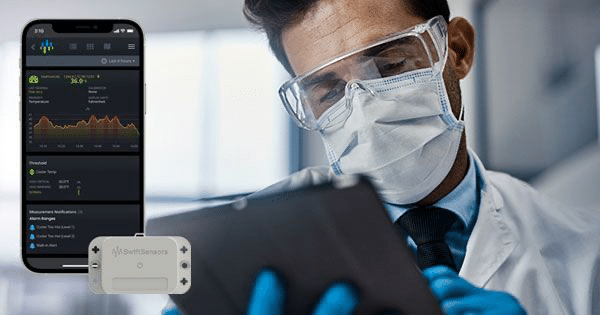
Continuous infusion center monitoring provides real-time visibility into cleanroom conditions, medication storage temperatures, and differential pressure – the data your surveyors expect.
Differential Pressure Monitoring and Airflow Verification
Differential pressure monitoring is arguably the most operationally critical component of infusion center monitoring because pressure failures create immediate contamination risk. When the positive pressure differential between your buffer room and anteroom drops below the 0.020-inch water column minimum, unfiltered air from less clean zones migrates into the compounding space. Unlike temperature drift, which compromises medications gradually, a pressure failure can introduce viable contaminants within minutes.
The practical challenge is that differential pressure fluctuates constantly. Door openings, HVAC cycling, personnel movement, and even weather changes can affect room-to-room pressure relationships. A manual pressure reading taken once per shift captures a single data point but misses the transient drops that occur dozens of times daily. Continuous differential pressure monitoring with automated alarming captures every excursion, giving your infusion center monitoring team the ability to respond before contamination conditions persist. According to Setra Systems, USP 797 and 800 require that differential pressure devices be verified in calibration per manufacturer recommendations or at least every 12 months.
For infusion centers handling both non-hazardous and hazardous drugs, the pressure requirements create a complex spatial design challenge. Your non-hazardous compounding suite needs positive pressure cascading outward from the PEC through the buffer room and into the anteroom. Your hazardous drug compounding area under USP 800 needs negative pressure to contain aerosolized agents. When these two suites share an anteroom, the pressure relationships must prevent cross-contamination in both directions simultaneously. Without continuous infusion center monitoring, verifying these relationships under dynamic conditions is functionally impossible.
Smoke studies remain a required component of your six-month recertification, but they represent a point-in-time assessment. Continuous infusion center monitoring through cleanroom monitoring between certifications fills the gap by documenting that pressure relationships remain within specification 24 hours a day, 7 days a week. This infusion center monitoring documentation serves a dual purpose: it satisfies the USP 797 requirement for “recorded and readily retrievable” data and provides your Quality Assurance team with actionable trend data to identify degrading HVAC performance before it causes a compliance failure.
Medication Storage and Beyond-Use Dating Compliance
Beyond the cleanroom environment, your infusion center monitoring program must encompass every storage location where medications await preparation and administration. This includes refrigerators and freezers holding biologic agents, controlled room temperature cabinets housing reconstituted medications, and transport containers used to move compounded preparations from the pharmacy to the infusion bay. Each location has specific temperature parameters that directly affect product potency and patient safety.
The financial exposure from unmonitored medication storage is substantial. A typical pharmacy refrigerator in an infusion center may hold $100,000 or more in inventory at any time. Immunoglobulin products, which represent 29.88% of the ambulatory infusion market according to Mordor Intelligence, are particularly sensitive to temperature excursions and prohibitively expensive to replace. Continuous infusion center monitoring with after-hours alarming provides the early warning system that prevents weekend or holiday refrigerator failures from becoming six-figure losses.
Beyond-use dating (BUD) compliance adds another dimension to your infusion center monitoring requirements. Under the revised USP 797, BUD assignment depends on the CSP category and the conditions under which it was prepared. Category 2 preparations compounded in compliant conditions receive longer BUDs than those made under less controlled circumstances. If your environmental monitoring data shows a temperature or humidity excursion during the compounding window, the BUD for every CSP prepared during that period must be shortened or the preparations must be discarded entirely. Without timestamped infusion center monitoring records, your pharmacy cannot defensibly assign BUDs that maximize operational efficiency.
Critical Storage Temperature Ranges for Infusion Medications
- Refrigerated biologics (monoclonal antibodies, immunoglobulins): 2 to 8 degrees C (36 to 46 degrees F)
- Frozen products (some chemotherapy agents): -25 to -10 degrees C (-13 to 14 degrees F)
- Controlled room temperature: 20 to 25 degrees C (68 to 77 degrees F), excursions to 15-30 degrees C
- Reconstituted/compounded CSPs: Per manufacturer labeling and USP 797 BUD assignment
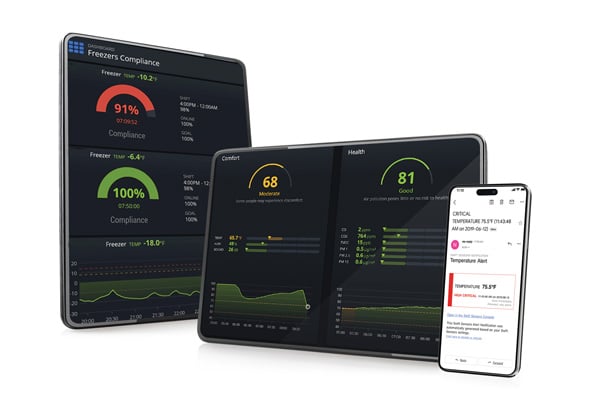
Automated temperature monitoring across refrigerators, freezers, and controlled room storage eliminates the gaps in manual logging that lead to undetected excursions and medication losses.
Documentation, Record-Keeping, and Audit Readiness
The documentation requirements in the revised USP 797 represent one of the most significant operational shifts for infusion center monitoring programs. Environmental data must be “recorded and readily retrievable” – a standard that effectively eliminates manual logbooks as a primary compliance tool. When a surveyor asks to see your differential pressure readings from three Tuesdays ago at 2:00 PM, you need to produce that data within minutes, not hours. Automated data logging systems provide the instant retrieval capability that manual processes cannot match.
The scope of required documentation extends well beyond simple parameter readings. Your infusion center monitoring records must include calibration verification for all measurement devices (at minimum annually), corrective action documentation when excursions occur, investigation reports when microbial action levels are exceeded (now including genus-level identification), personnel competency records for garbing and aseptic technique, and cleaning and disinfection logs. Each of these records must be maintained for a period defined by your state board of pharmacy, which often extends to three or more years.
Accreditation surveys from The Joint Commission, ACHC, and state boards of pharmacy follow predictable patterns in their environmental monitoring reviews. Surveyors typically request temperature logs spanning the past 30 to 90 days, ask to see your excursion response procedures and evidence of their execution, verify that monitoring devices are within their calibration windows, and review your corrective action and preventive action (CAPA) documentation. Facilities with continuous infusion center monitoring platforms can produce this information on demand, while those relying on manual logs often spend days preparing for surveys.
State pharmacy board compliance adds another documentation layer. Many states have adopted the revised USP 797 standards by reference, but some have imposed additional requirements or accelerated enforcement timelines. California, for example, requires pharmacies to maintain quality assurance records related to automated dispensing and compounding activities under Assembly Bill 1286. Understanding your state’s specific requirements alongside USP 797 helps ensure your infusion center monitoring program satisfies all applicable authorities.
Is Your Infusion Center Ready for the Next Survey?
Discover how continuous monitoring can protect your pharmacy license and keep your environmental data audit-ready. Our experts will assess your current monitoring gaps and show you exactly what surveyors expect to see.
Why Monitoring as a Service Solves the Infusion Center Compliance Gap
Most infusion centers face a fundamental resource constraint when implementing comprehensive infusion center monitoring: the expertise and capital required to deploy, calibrate, maintain, and validate monitoring infrastructure across cleanrooms, medication storage, and HVAC systems exceeds what a typical pharmacy staff can manage alongside patient care responsibilities. Purchasing monitoring equipment outright creates upfront costs that can reach $50,000 to $100,000 for a single compounding suite, followed by ongoing calibration, software licensing, and sensor replacement expenses that strain operating budgets.
Monitoring as a Service eliminates this barrier by delivering continuous environmental surveillance as an operational expense rather than a capital investment. Instead of purchasing sensors, installing networking infrastructure, configuring alerting systems, and hiring staff to manage them, your infusion center receives a fully managed infusion center monitoring platform that covers temperature, humidity, differential pressure, and water leak detection across your entire facility. The service includes sensor deployment, calibration management, 24/7 alert monitoring, and the documentation platform your surveyors need to see.
For infusion centers operating in leased space or planning expansion, the MaaS model offers particular advantages. Sensors and infrastructure scale with your operations without requiring additional capital approval. When you add a second compounding suite or expand your medication storage capacity, the infusion center monitoring coverage expands with it. Healthcare building automation through a managed service also provides the data integration capabilities that connect your environmental monitoring to building management and predictive maintenance programs, identifying HVAC degradation before it causes a compliance excursion.
The comparison between traditional approaches and managed infusion center monitoring is significant for operations. Manual logging requires pharmacy technician time that could be spent on patient care, creates gaps during nights, weekends, and holidays, and produces records that are difficult to retrieve during surveys. Purchased monitoring systems deliver continuous data but require capital expenditure, in-house IT support, and ongoing maintenance that many ambulatory centers cannot staff. Monitoring as a Service combines continuous infusion center monitoring data collection with managed infrastructure, calibration compliance, and instant audit retrieval – delivered at a predictable monthly cost that aligns with the operational reality of infusion center budgets.
| Capability | Manual Logging | Purchased System | MaaS Solution |
|---|---|---|---|
| 24/7 Coverage | Business hours only | Yes (if maintained) | Yes, fully managed |
| Calibration Management | Staff responsibility | Staff responsibility | Included in service |
| Instant Audit Retrieval | No (paper search) | Varies by vendor | Yes, cloud-based |
| Upfront Capital Cost | Low ($500-$2K) | High ($50K-$100K+) | None (monthly fee) |
| After-Hours Alerts | None | If configured | Included, 24/7 |
| Scalability | Limited by staff | Requires new investment | Add sensors as needed |
Frequently Asked Questions About Infusion Center Monitoring
What environmental parameters does USP 797 require infusion centers to monitor?
USP 797 requires infusion center monitoring of temperature, humidity, and differential pressure in all classified compounding areas, with data that is recorded and readily retrievable. Cleanroom suites must maintain temperatures at 20 degrees C or cooler and humidity below 60%. Differential pressure between ISO classified areas must remain at or above 0.020-inch water column. Additionally, viable volumetric air sampling, surface sampling, and gloved fingertip sampling are required at frequencies tied to your CSP category. All monitoring data must be available for surveyor review on demand, making automated logging systems a practical requirement for compliance.
How does the revised USP 797 Category system affect monitoring requirements?
The 2023 USP 797 revision replaced the low/medium/high-risk classification with Categories 1, 2, and 3, each carrying different infusion center monitoring obligations. Category 1 CSPs involve simple preparations with the shortest beyond-use dates and require basic environmental controls. Category 2 CSPs – the most common in infusion centers – require full cleanroom suites with ISO Class 5 primary engineering controls, ISO Class 7 buffer rooms, and ISO Class 8 anterooms, all with continuous environmental monitoring. Category 3 preparations demand the most stringent controls, including mandatory sterility testing. Your monitoring program must align with the highest category your facility compounds.
What happens if my infusion center’s environmental monitoring shows an excursion?
When your infusion center monitoring system detects an environmental excursion, USP 797 requires a documented corrective action process. For temperature or humidity excursions during compounding, the beyond-use dates of all CSPs prepared during the affected period may need to be shortened or the preparations discarded. If microbial action levels are exceeded, the revised standard now requires genus-level identification of the organism to enable root cause analysis. Your facility must document the excursion, the investigation findings, corrective actions taken, and evidence that conditions returned to specification. Continuous infusion center monitoring with automated alerting ensures excursions are caught in real time rather than discovered hours or days later.
How often must cleanrooms in infusion centers be recertified?
USP 797 mandates that cleanrooms and primary engineering controls in infusion centers be independently certified before compounding begins and recertified every six months thereafter. Recertification must also occur whenever changes are made that could impact airflow or air quality, such as HVAC modifications, HEPA filter replacement, or facility renovations. The certification process includes airflow velocity measurements, HEPA filter integrity testing, particle counts, and smoke studies verifying unidirectional airflow. Infusion center monitoring between certifications provides the continuous data that demonstrates environmental compliance throughout the full six-month cycle, not just on the day of the certification visit. Your ISO classification documentation must be current at all times.
What is the difference between USP 797 and USP 800 monitoring requirements?
USP 797 governs sterile compounding environments for all CSPs, while USP 800 adds specific requirements for hazardous drug handling that directly affect infusion center monitoring configurations. The critical distinction is pressure direction: USP 797 non-hazardous compounding requires positive pressure rooms to prevent contaminant ingress, while USP 800 hazardous drug compounding requires negative pressure rooms to contain aerosolized agents. Infusion centers administering chemotherapy must comply with both chapters simultaneously, creating complex airflow relationships that demand continuous differential pressure monitoring. Both standards require environmental data that is recorded and readily retrievable, and both became enforceable on November 1, 2023. Understanding where your USP 800 monitoring obligations overlap with 797 prevents duplication of effort and monitoring infrastructure.
How should infusion centers monitor medication storage temperatures?
Comprehensive infusion center monitoring for medication storage must cover every refrigerator, freezer, and controlled room temperature area where drugs are held before preparation and administration. Refrigerated biologics require continuous monitoring between 2 and 8 degrees C, frozen agents between -25 and -10 degrees C, and controlled room temperature medications between 20 and 25 degrees C per USP standards. Each storage unit should have continuous temperature logging with alarm thresholds set narrower than the acceptable range to provide early warning before excursions reach damaging levels. For facilities storing high-value oncology and immunoglobulin products, a single temperature excursion can destroy $50,000 or more in inventory, making continuous monitoring a financial safeguard as well as a compliance requirement.
What accreditation standards apply to infusion center environmental monitoring?
Multiple accreditation bodies set environmental monitoring standards for infusion centers. The Joint Commission evaluates environmental controls under its Environment of Care standards for hospital-based infusion suites. ACHC (Accreditation Commission for Health Care) offers specific Infusion Pharmacy accreditation that incorporates USP 797 and 800 requirements, including a designation for infusion pharmacies without sterile compounding. NICA (National Infusion Center Association) developed the first ANSI-approved standards specifically for ambulatory infusion centers. CMS Conditions of Participation apply to hospital-based centers receiving Medicare reimbursement. Your infusion center monitoring program should be designed to satisfy all applicable accreditation bodies simultaneously, as each may request environmental data documentation during surveys.
Can small ambulatory infusion centers comply with USP 797 without a large capital investment?
Yes. Small ambulatory infusion centers can achieve full USP 797 compliance through Monitoring as a Service models that eliminate the large capital expenditure traditionally associated with environmental monitoring infrastructure. Instead of purchasing sensors, networking equipment, and monitoring software outright, a MaaS provider delivers a turnkey monitoring solution as a monthly operational expense. This approach provides continuous infusion center monitoring of temperature, humidity, differential pressure, and other parameters with 24/7 alerting, cloud-based data retrieval for audits, and managed calibration – all without requiring dedicated IT staff or upfront investment. For single-suite ambulatory centers operating on tight margins, MaaS makes enterprise-grade compliance accessible at a fraction of the capital cost.
Protect Your Patients, Your Pharmacy License, and Your Medications
Your infusion center monitoring obligations under USP 797 require continuous, documented environmental surveillance that manual processes cannot deliver. Our team specializes in healthcare facility monitoring and will show you exactly where your compliance gaps exist.
- + Continuous temperature, humidity, and differential pressure monitoring
- + 24/7 alerting with after-hours escalation to protect medication inventory
- + Instant audit retrieval for Joint Commission, ACHC, and state pharmacy board surveys
- + Managed calibration and sensor maintenance included in service
- + No capital expenditure – predictable monthly operational cost
Email us at detect@envigilance.com | We reply within 24 hours