Plasma Center Temperature Monitoring: Complete FDA 21 CFR 606 Compliance Guide 2026
A single temperature excursion at a plasma collection center can trigger FDA enforcement action and destroy inventory worth $50,000 or more in a matter of hours. Under 21 CFR 606.122, plasma products must be maintained at precise temperatures from collection through storage, with documentation requirements that leave no room for gaps or guesswork. Yet many plasma centers still rely on manual temperature logs checked two or three times per shift – a practice that creates 8 to 12 hour blind spots where undetected excursions can compromise entire product inventories.
The financial stakes are significant. A typical plasma collection center processes 400 to 600 donations per week, with each unit valued at $150 to $300 depending on the protein content and intended use. A refrigeration failure that goes undetected overnight can destroy an entire week’s inventory – a loss of $60,000 to $180,000 before accounting for regulatory consequences. FDA Form 483 observations related to temperature control failures can trigger warning letters, consent decrees, and in severe cases, facility license revocation.
Plasma center temperature monitoring technology now makes continuous compliance both practical and affordable. Automated systems track temperatures around the clock, alert staff to excursions within minutes, and generate the documentation trail that FDA investigators expect to see during inspections. For plasma collection centers seeking to protect both their inventory and their operating licenses, implementing robust plasma center temperature monitoring has shifted from optional improvement to operational necessity.
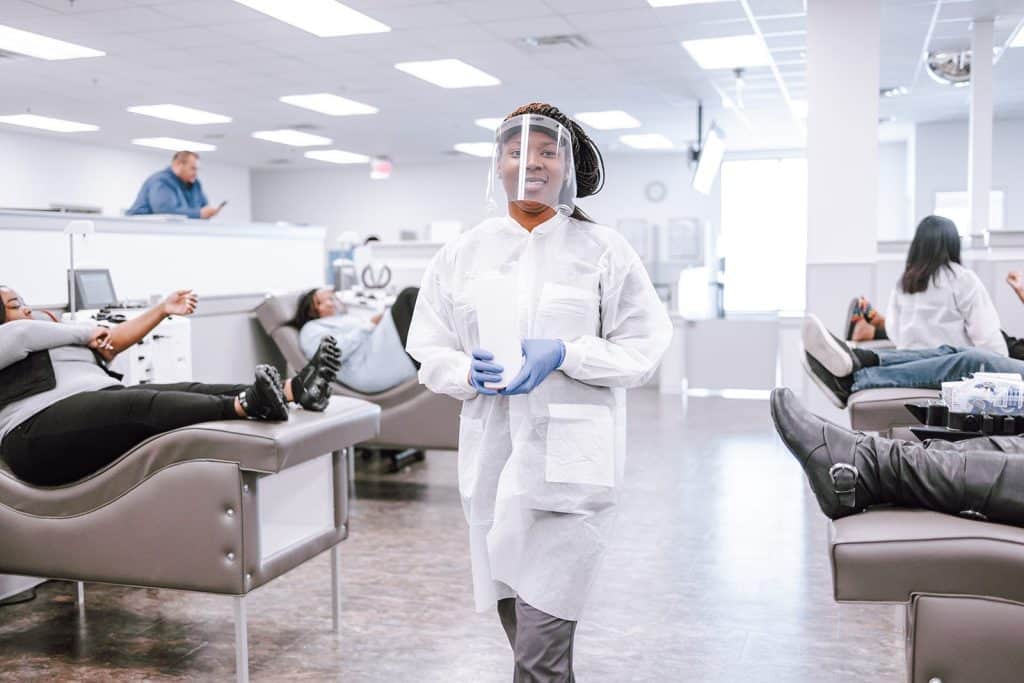
Plasma products require strict temperature control under FDA regulations. Continuous monitoring eliminates the documentation gaps that lead to Form 483 observations.
Understanding FDA 21 CFR 606 Temperature Requirements
The regulatory foundation for plasma center temperature monitoring comes from 21 CFR Part 606, which establishes Current Good Manufacturing Practice (CGMP) requirements for blood and blood components. These regulations are not suggestions – they carry the force of law, and FDA investigators conduct unannounced inspections to verify compliance. Understanding exactly what the regulations require helps you design plasma center temperature monitoring systems that satisfy inspectors and protect your operating license.
Section 606.122 specifically addresses temperature requirements during storage. Fresh Frozen Plasma (FFP) must be stored at -18°C (0°F) or colder. Plasma Frozen Within 24 Hours (PF24) carries the same requirement. Liquid plasma intended for further manufacturing must be stored at 1-6°C (34-43°F). Source Plasma for fractionation requires storage at -20°C (-4°F) or colder. These are not target ranges with acceptable variation – they are hard limits that your plasma center temperature monitoring must verify continuously.
Beyond storage temperatures, 21 CFR 606 establishes requirements for the entire cold chain. Section 606.121 addresses container labeling, including temperature storage requirements. Section 606.140 requires facilities to establish and follow written procedures for storage, and Section 606.160 mandates records that document compliance with those procedures. Your plasma center temperature monitoring system must support all of these requirements, not just the storage temperatures themselves.
FDA 21 CFR 606 Temperature Requirements Summary
- Fresh Frozen Plasma (FFP): -18°C (0°F) or colder
- Plasma Frozen Within 24 Hours (PF24): -18°C (0°F) or colder
- Liquid Plasma: 1-6°C (34-43°F)
- Source Plasma: -20°C (-4°F) or colder
- Transport: Must maintain required temperatures throughout transit
The documentation requirements deserve particular attention because they directly impact your plasma center temperature monitoring strategy. Under 21 CFR 606.160, you must maintain records that permit complete traceability of each unit from donor to final disposition. Temperature records are a critical component of this traceability. FDA investigators will examine whether your records demonstrate continuous compliance – not just spot checks that happened to fall within range. Manual logs with readings every 4 or 8 hours simply cannot provide this level of assurance.
AABB Standards, which many plasma centers follow in addition to FDA regulations, add further specificity to temperature monitoring requirements. AABB requires continuous temperature recording or monitoring at intervals not to exceed 4 hours, with alarm systems that activate when temperatures deviate from acceptable ranges. While FDA regulations establish the legal minimum, AABB Standards often represent the practical implementation that satisfies both regulators and accreditation bodies.

Continuous plasma center temperature monitoring eliminates the blind spots between manual checks, alerting staff to excursions before inventory loss occurs.
Why Manual Temperature Logging Fails FDA Scrutiny
Many plasma collection centers still rely on manual temperature logs where staff members check and record thermometer readings two or three times per shift. This approach might seem adequate – after all, you are documenting temperatures regularly. But FDA investigators have seen enough temperature-related product failures to know that manual logging creates dangerous blind spots. Understanding why manual methods fail helps you appreciate the value of automated plasma center temperature monitoring.
The fundamental problem is coverage gaps. If a staff member records a temperature at 8:00 AM and again at 4:00 PM, what happened during those 8 hours? A compressor could fail at 8:30 AM, temperatures could rise above acceptable limits by 10:00 AM, and the excursion would continue undetected for 6 hours. By the time the afternoon check reveals the problem, the damage is done. With plasma center temperature monitoring systems that record continuously, you would have received an alert within minutes of the excursion beginning.
Overnight and weekend coverage presents even greater challenges for facilities without automated plasma center temperature monitoring. Most plasma centers operate during daytime hours, but storage units run continuously. A freezer failure that occurs at 2:00 AM Saturday will not be discovered until staff arrive Monday morning – potentially 60 hours of uncontrolled temperatures. The healthcare industry has largely moved to continuous monitoring precisely because of these overnight vulnerability windows. This shift parallels trends in indoor air quality monitoring where around-the-clock coverage has become the standard.
Human error compounds the coverage gap problem. Staff members may forget to take readings during busy periods. They may record temperatures incorrectly. They may round numbers or estimate readings. They may backfill logs at the end of a shift rather than recording in real time. FDA investigators are trained to spot these patterns, and they raise immediate credibility concerns about your entire quality system. Automated plasma center temperature monitoring eliminates these human factors entirely.
Common Manual Logging Failures
- Coverage gaps: 4-12 hours between readings where excursions go undetected
- Overnight blindness: No monitoring during non-operating hours when failures commonly occur
- Recording errors: Transposed digits, illegible handwriting, incorrect units
- Backfilling: Logs completed at end of shift rather than in real time
- No audit trail: Cannot prove when readings were actually taken
The audit trail issue deserves special emphasis. Modern regulatory compliance requires not just data, but provable data integrity. When an FDA investigator asks how you know a temperature reading was taken at the time recorded, manual logs offer no satisfactory answer. Automated plasma center temperature monitoring systems timestamp every reading automatically, store data in tamper-evident formats, and maintain complete audit trails that demonstrate exactly when each measurement occurred. This data integrity is what separates facilities that sail through inspections from those that receive Form 483 observations.
Consider also the investigation burden when problems occur. If a product quality issue traces back to potential temperature excursion, you need to prove that temperatures remained within range throughout storage. With manual logs, you can only point to the specific times readings were taken. With continuous plasma center temperature monitoring, you can demonstrate temperature compliance for every minute of storage – a dramatically stronger position when defending product quality decisions.
Essential Components of Plasma Center Temperature Monitoring Systems
Implementing effective plasma center temperature monitoring requires understanding the key components that work together to provide continuous coverage, reliable alerts, and compliant documentation. The technology has advanced significantly in recent years, making sophisticated monitoring accessible to plasma centers of any size. Here is what a comprehensive plasma center temperature monitoring system includes.
Temperature sensors form the foundation of any plasma center temperature monitoring system. For frozen plasma storage, you need sensors rated for extreme cold that maintain accuracy at -20°C and below. Sensor placement matters – a single sensor in a large freezer may not capture temperature variations throughout the unit. Best practice involves multiple sensors positioned to monitor different zones, particularly near doors where temperature fluctuations are greatest. Sensors should be NIST-traceable and calibrated according to a documented schedule.
Data loggers or connected IoT devices capture sensor readings and transmit them to your monitoring platform. Modern plasma center temperature monitoring uses wireless connectivity to eliminate the cable runs that complicate installation and create failure points. Devices should store data locally as a backup in case of network interruptions, then sync automatically when connectivity resumes. Battery backup ensures continued monitoring during power outages – precisely when temperature excursions are most likely to occur.
The monitoring platform aggregates data from all sensors, applies alert logic, and provides the dashboards and reports you need for compliance. Cloud-based platforms offer advantages for plasma center temperature monitoring: they are accessible from anywhere, automatically updated, and maintain data redundancy that protects against local hardware failures. Look for platforms that support the specific reporting formats FDA expects and integrate with your existing quality management systems. The same principles that guide building energy monitoring platform selection apply here – reliability, accessibility, and regulatory alignment.
Core System Components
- Temperature sensors: NIST-traceable, rated for required temperature ranges, multiple per unit
- Data loggers/IoT devices: Wireless connectivity, local storage backup, battery backup
- Monitoring platform: Cloud-based, FDA-compliant reporting, quality system integration
- Alert system: Multi-channel notifications (SMS, email, phone), escalation protocols
- Reporting tools: Automated compliance reports, trend analysis, calibration tracking
Alert systems must be robust enough to ensure someone always responds to temperature excursions. Your plasma center temperature monitoring should support multiple notification channels – text messages, phone calls, emails, and on-site alarms. Escalation protocols ensure that if the first responder does not acknowledge an alert within a defined timeframe, the system contacts additional staff. Alert thresholds should be set to provide early warning before temperatures actually exceed regulatory limits, giving staff time to respond before product is compromised.
Integration with building energy monitoring and facility management systems adds another layer of intelligence to your plasma center temperature monitoring. When you can correlate temperature data with HVAC performance, power consumption, and indoor air quality, you gain insights that help prevent excursions rather than just detecting them. A gradual increase in compressor runtime might indicate developing problems before they cause temperature failures.
Implementing Monitoring Across the Plasma Cold Chain
Effective plasma center temperature monitoring extends beyond storage freezers to cover every point where temperature control matters. The cold chain for plasma products begins at collection and continues through processing, storage, and transport. Each stage presents unique monitoring challenges that your system must address to maintain complete regulatory compliance.
At the collection point, fresh plasma must be frozen within specified timeframes to meet product specifications. FFP requires freezing within 8 hours of collection; PF24 extends this to 24 hours. Your plasma center temperature monitoring should track not just storage temperatures but also time-to-freeze metrics that document compliance with these processing windows. Alerts can notify staff when units approach their freezing deadlines, preventing inadvertent specification failures.
Processing areas where plasma is separated, pooled, or prepared for shipment require temperature monitoring appropriate to the products being handled. Work-in-process refrigerators, centrifuge areas, and packaging stations all need coverage. The challenge is balancing monitoring thoroughness with practical workflow – sensors and data loggers should not impede the efficient movement of products through your facility.
Storage represents the longest phase of the cold chain and typically the most straightforward to monitor. Your plasma center temperature monitoring should cover every freezer and refrigerator holding regulated products. Consider monitoring non-product areas as well – if your building experiences an HVAC failure that raises ambient temperatures, that information helps you assess risk to storage equipment even if the units themselves maintain temperature.

Real-time dashboards transform plasma center temperature monitoring from reactive documentation to proactive inventory protection.
Transport monitoring presents unique challenges because products leave your controlled facility environment. Validated shipping containers with integrated temperature loggers document conditions during transit. Your plasma center temperature monitoring platform should be able to incorporate transport data, maintaining a complete temperature record from collection through delivery to the fractionator or end user. Some systems use cellular-connected loggers that transmit data in real time during transport.
The food processing and warehouse industries have developed sophisticated cold chain monitoring approaches that plasma centers can adapt. The principles are similar: continuous monitoring at every stage, automated alerts for excursions, and complete documentation that proves compliance throughout the product journey. The specific temperature requirements differ, but the monitoring infrastructure translates directly.
Documentation and Reporting for FDA Compliance
FDA investigators do not just want to know that you monitor temperatures – they want to see documented evidence that demonstrates continuous compliance. Your plasma center temperature monitoring system must generate reports and maintain records that satisfy regulatory scrutiny. Understanding what investigators look for helps you configure your system to produce the documentation that keeps inspections on track.
Continuous temperature logs showing readings at defined intervals (typically every 1-15 minutes) form the core documentation. These logs should include timestamps, sensor identification, temperature readings, and any alarm conditions. Data must be stored in formats that prevent unauthorized modification – investigators are trained to spot signs of data manipulation. Your plasma center temperature monitoring platform should maintain audit trails showing who accessed records and when.
Excursion reports document every instance where temperatures deviated from acceptable ranges, no matter how brief. Each report should capture the excursion start and end times, maximum deviation, affected storage units, products potentially impacted, and corrective actions taken. Your plasma center temperature monitoring system should generate these reports automatically, ensuring consistent documentation regardless of which staff member responds to the alert.
Required Documentation Elements
- Continuous temperature logs: Timestamped readings at regular intervals, tamper-evident storage
- Excursion reports: Deviation details, affected products, corrective actions, disposition decisions
- Calibration records: Sensor calibration dates, results, next due dates, NIST traceability
- Alert response logs: Who was notified, response times, actions taken
- System validation: Installation qualification, operational qualification, performance qualification
Calibration records demonstrate that your sensors produce accurate readings. Document calibration procedures, results, and schedules. NIST traceability means you can trace your calibration standards back to national measurement standards. Most plasma center temperature monitoring platforms include calibration management features that track due dates and store calibration certificates.
System validation documentation proves that your plasma center temperature monitoring performs as intended. This includes Installation Qualification (IQ) confirming proper installation, Operational Qualification (OQ) verifying the system operates correctly, and Performance Qualification (PQ) demonstrating it meets your specific requirements under actual operating conditions. Maintain these validation records and update them when you modify the system.
Trend analysis reports help you identify patterns before they become problems. Gradual temperature drift might indicate developing equipment issues. Seasonal variations might reveal vulnerability to ambient temperature changes. Your plasma center temperature monitoring platform should support trend visualization and analysis that enables proactive maintenance rather than reactive crisis response. This capability also demonstrates to investigators that you use monitoring data actively rather than just collecting it.
Is Your Plasma Center Protected Around the Clock?
Discover how continuous monitoring can protect your plasma inventory and simplify FDA compliance. Our experts will assess your current temperature monitoring capabilities and show you exactly where gaps exist.
Responding to Temperature Excursions
Even the best plasma center temperature monitoring cannot prevent all equipment failures – but it can ensure you respond quickly enough to minimize damage. Having documented procedures for excursion response, and staff trained to execute them, transforms temperature alerts from emergencies into manageable events. Your response procedures should be detailed, practiced, and immediately accessible to anyone who might receive an alert.
Immediate response priorities focus on stopping the excursion and protecting unaffected product. If a freezer fails, can affected units be transferred to backup storage? If a door was left ajar, close it and assess the temperature trend. If a power outage occurred, activate backup power or begin emergency protocols. Your plasma center temperature monitoring alert should trigger a clear decision tree that guides responders through these initial steps.
Product assessment determines whether affected plasma can be released, requires further evaluation, or must be discarded. FDA regulations require that you establish maximum allowable excursion times and temperatures for each product type. For example, FFP that has been exposed to temperatures above -18°C for more than a specified duration may need to be relabeled, diverted to manufacturing, or destroyed. Your plasma center temperature monitoring data provides the precise exposure information needed for these decisions.
Documentation during excursion response is critical. Record every action taken, by whom, and when. Capture the plasma center temperature monitoring data showing the excursion parameters. Document product disposition decisions and the rationale supporting them. This documentation protects you during FDA inspections and provides the basis for any subsequent quality investigations. Rushing to fix the problem without documenting your response creates compliance risks that compound the original equipment failure.
Excursion Response Checklist
- Immediate: Identify cause, stop ongoing damage, protect unaffected inventory
- Assessment: Review monitoring data for exposure duration and maximum temperature
- Disposition: Apply established criteria to determine product fate
- Documentation: Record all actions, decisions, and supporting rationale
- Root cause: Investigate why the excursion occurred and implement preventive measures
Root cause investigation should follow every significant excursion. Why did the equipment fail? Why did the alarm take as long as it did to reach responders? What could prevent recurrence? Your plasma center temperature monitoring data often contains clues – gradual temperature changes before failure might indicate compressor degradation, while sudden changes suggest acute failures like power interruption or door breaches. Use these insights to strengthen your systems. Integrating with energy monitoring can reveal power fluctuations that precede equipment failures.
Corrective and preventive action (CAPA) processes formalize the lessons learned from excursions. FDA expects to see documented CAPA records showing that you investigate problems, identify root causes, implement corrections, and verify effectiveness. Your plasma center temperature monitoring system provides the data that drives this continuous improvement cycle. Facilities that treat excursions as learning opportunities rather than just crises consistently perform better in FDA inspections.
Monitoring as a Service for Plasma Collection Centers
Traditional approaches to plasma center temperature monitoring required significant capital investment in hardware, software, and IT infrastructure. Many plasma centers delayed implementation because they could not justify the upfront costs or lacked the technical expertise to deploy and maintain complex systems. Monitoring as a Service (MaaS) changes this equation, making enterprise-grade plasma center temperature monitoring accessible to facilities of any size.
The MaaS model shifts plasma center temperature monitoring from capital expense to predictable operating expense. Instead of purchasing sensors, data loggers, servers, and software licenses, you subscribe to a complete service that includes all hardware, the monitoring platform, connectivity, and ongoing support. Sensors deploy quickly without major IT projects. The platform stays current with evolving FDA expectations without requiring you to manage updates. You gain sophisticated monitoring capabilities at a fraction of the traditional cost. Many facilities combine this with water leak detection for comprehensive facility protection.
For plasma collection centers specifically, MaaS platforms offer pre-configured templates that address FDA 21 CFR 606 requirements. Alert thresholds, reporting formats, and documentation workflows are designed around regulatory expectations from the start. You do not need to figure out what FDA wants – the platform embodies that knowledge. This regulatory alignment accelerates deployment and reduces compliance risk during the transition from manual logging to automated plasma center temperature monitoring. Similar templates exist for healthcare facilities managing vaccine storage and pharmaceutical products.
The service model also provides expertise that most plasma centers cannot maintain in-house. When you have questions about sensor placement, alert configuration, or report generation, you have access to specialists who work with temperature monitoring systems daily. When FDA guidance changes, the service provider updates the platform accordingly. This ongoing expertise is particularly valuable for smaller plasma centers that cannot justify dedicated monitoring specialists on staff.
Scalability becomes straightforward with MaaS plasma center temperature monitoring. Opening a new collection center? Add monitoring coverage by deploying sensors and connecting them to your existing platform. Expanding storage capacity? Additional sensors integrate seamlessly with energy monitoring and water leak detection capabilities. The infrastructure scales with your operations without requiring new capital investment or system replacements. Organizations operating multiple plasma centers across different regions can standardize on a single platform while accommodating local variations in equipment and procedures.
The retail and manufacturing sectors have demonstrated the value of MaaS approaches for regulatory compliance. Plasma centers following this proven model benefit from lessons learned across industries while receiving solutions tailored to their specific FDA requirements. The combination of regulatory expertise, operational simplicity, and predictable costs makes MaaS the practical path to comprehensive plasma center temperature monitoring for most facilities.
Frequently Asked Questions About Plasma Center Temperature Monitoring
What temperature must frozen plasma be stored at under FDA regulations?
Under 21 CFR 606.122, Fresh Frozen Plasma (FFP) and Plasma Frozen Within 24 Hours (PF24) must be stored at -18°C (0°F) or colder. Source Plasma intended for fractionation requires storage at -20°C (-4°F) or colder. These are minimum requirements – many plasma centers target lower temperatures to provide a safety margin. Liquid plasma for further manufacturing must be stored at 1-6°C (34-43°F). Your plasma center temperature monitoring system should be configured to alert before temperatures reach these regulatory limits, giving staff time to respond before compliance is compromised.
How often should plasma storage temperatures be recorded?
FDA regulations require records that demonstrate continuous compliance, but do not specify exact recording intervals. AABB Standards require monitoring at intervals not exceeding 4 hours for manual systems. However, best practice for automated plasma center temperature monitoring is recording at 1 to 15 minute intervals. This frequency provides detailed data for excursion investigations, demonstrates thorough compliance during FDA inspections, and captures temperature fluctuations that less frequent monitoring might miss. Modern monitoring systems handle high-frequency recording automatically without additional effort.
What happens if plasma experiences a temperature excursion?
The disposition of plasma that experiences temperature excursion depends on the duration and severity of the deviation. Brief excursions within established tolerances may allow product to remain as originally labeled. Longer or more severe excursions might require relabeling (for example, FFP relabeled as plasma for manufacturing), quality review, or destruction. Your facility must have written procedures defining acceptable excursion parameters and disposition criteria. Plasma center temperature monitoring provides the precise exposure data needed to make these determinations. All excursions must be documented regardless of product disposition.
Do temperature monitoring sensors require calibration?
Yes, temperature sensors used in plasma center temperature monitoring must be calibrated according to a documented schedule, typically annually or more frequently depending on the sensor type and manufacturer recommendations. Calibration must be traceable to NIST (National Institute of Standards and Technology) or equivalent national standards. Your monitoring system should track calibration dates and alert when sensors approach their calibration due dates. Maintain calibration certificates and records as part of your quality documentation. Using out-of-calibration sensors can invalidate your temperature records and create FDA compliance issues.
How quickly should staff respond to temperature alarms?
Response time requirements should be defined in your written procedures based on the rate at which temperatures can change in your storage equipment. Generally, staff should acknowledge alarms within 15 to 30 minutes and begin corrective action immediately. Your plasma center temperature monitoring system should support escalation protocols that contact additional staff if the initial responder does not acknowledge within defined timeframes. Document your response time requirements and train all staff who might receive alerts. Review actual response times periodically and adjust staffing or procedures if targets are not being met consistently.
What documentation do FDA inspectors want to see for temperature monitoring?
FDA investigators typically request continuous temperature logs covering the period under review, records of any temperature excursions and their investigation, sensor calibration records demonstrating NIST traceability, validation documentation for your monitoring system, written procedures for temperature monitoring and excursion response, and training records for staff involved in monitoring activities. Your plasma center temperature monitoring system should generate reports in formats that facilitate inspector review. Having organized, readily accessible documentation demonstrates control over your quality systems and typically leads to smoother inspections.
Can I use the same monitoring system for plasma and vaccines?
Yes, modern plasma center temperature monitoring platforms can monitor multiple product types with different temperature requirements simultaneously. The system maintains separate alarm thresholds and reporting for each storage unit based on what it contains. Many facilities that handle both plasma products and vaccines benefit from unified monitoring that provides consistent documentation and centralized alerting. The underlying technology is the same – the configuration determines which regulatory requirements each sensor addresses. This approach also simplifies training since staff learn one system rather than multiple platforms.
How much does plasma center temperature monitoring cost?
Costs vary based on facility size, number of storage units, and monitoring sophistication required. Traditional capital purchase approaches might involve $10,000 to $50,000 in upfront hardware and software costs plus ongoing maintenance. Monitoring as a Service models convert plasma center temperature monitoring from a large capital expense into a predictable monthly service fee covering all hardware, software, connectivity, and support. When evaluating costs, consider the value of inventory at risk from undetected excursions, the cost of FDA enforcement actions, and the staff time saved by automated documentation. For most plasma centers, continuous monitoring pays for itself by preventing a single significant inventory loss.
Protect Your Plasma Inventory and Operating License
FDA compliance deadlines wait for no one. Every hour without continuous plasma center temperature monitoring is an hour where undetected excursions can destroy inventory and trigger regulatory action. Take control of your cold chain with monitoring that works around the clock.
- + Continuous monitoring eliminates blind spots between manual checks
- + Instant alerts ensure rapid response to temperature excursions
- + Automated documentation satisfies FDA 21 CFR 606 requirements
- + Complete audit trails simplify regulatory inspections
- + Rapid deployment without major capital investment
Email us at detect@envigilance.com | We reply within 24 hours